Inequalities in Maternal Health Service Utilisation in Somalia
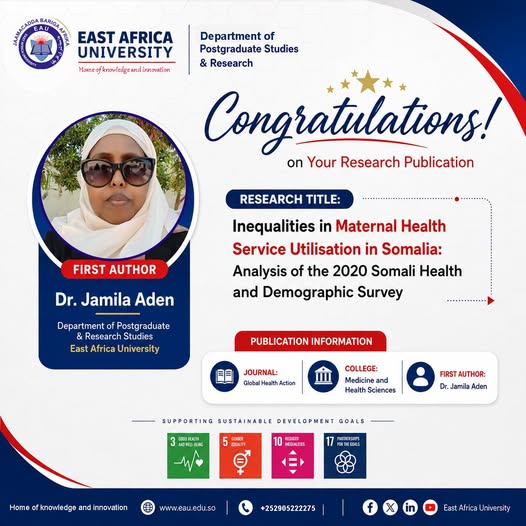
East Africa University is proud to announce that Dr. Jamila Aden, a distinguished researcher and faculty member, has published a landmark study in Global Health Action, one of the leading international journals in public health and epidemiology.
The research paper provides a comprehensive examination of the systemic barriers and disparities that continue to limit maternal healthcare access across Somalia.
Why This Research Matters
Maternal mortality remains one of the most pressing public health challenges in Somalia. According to recent estimates, Somalia has one of the highest maternal mortality ratios in the world, with approximately 692 deaths per 100,000 live births. This means that a Somali woman's risk of dying from pregnancy-related causes is among the highest globally.
Despite international commitments and national efforts to improve maternal health, significant disparities persist. Understanding the factors that drive these inequalities is essential for developing effective policies and interventions.
Dr. Aden's research addresses this critical gap by providing rigorous, evidence-based analysis of the determinants of maternal health service utilization in Somalia.
Key Findings
Dr. Aden's research analyzed data from over 15,000 households across all federal member states of Somalia. The study revealed several critical insights:
1. Geographic Disparities
Women in rural and remote areas are 3.5 times less likely to receive skilled birth attendance compared to their urban counterparts. The study identified that:
- Distance to health facilities
- Lack of transportation
- Insecurity and conflict
- Limited availability of skilled health workers
remain the most significant barriers in rural and hard-to-reach areas.
2. Socioeconomic Factors
Household wealth quintile is strongly correlated with maternal health service utilization:
- Women from the poorest households are 60% less likely to have institutional deliveries
- Wealthier women are more likely to receive antenatal care, skilled delivery, and postnatal care
- Out-of-pocket expenses for maternal health services remain a significant barrier for poor households
3. Education as a Determinant
Maternal education emerged as one of the strongest predictors of healthcare utilization:
- Women with secondary or higher education are four times more likely to access antenatal care
- Educated women are more likely to deliver in health facilities
- Education is associated with better knowledge of danger signs during pregnancy
4. Regional Variations
Significant disparities exist between federal member states. The study provides disaggregated data for:
- Puntland
- Somaliland
- South West State
- Jubaland
- Hirshabelle
- Galmudug
This regional analysis highlights areas requiring urgent policy attention and targeted interventions.
Policy Recommendations
Based on the findings, Dr. Aden and her research team recommend the following policy interventions:
1. Expand Community-Based Health Services
- Increase the deployment of skilled community health workers to underserved areas
- Strengthen community health programs that provide antenatal care and health education
- Implement outreach services for remote and nomadic populations
2. Strengthen Health Infrastructure
- Invest in primary health centers and referral systems
- Improve emergency obstetric care services
- Ensure availability of essential medicines and supplies
- Address infrastructure gaps in conflict-affected regions
3. Promote Female Education
- Address the link between girls' education and improved maternal outcomes
- Implement targeted initiatives to keep girls in school
- Provide health education in schools and communities
4. Innovative Financing
- Explore conditional cash transfer programs
- Develop health insurance schemes to reduce financial barriers
- Advocate for increased government health spending
5. Data-Driven Decision Making
- Strengthen health information systems
- Enable continuous monitoring and evaluation
- Use data to identify gaps and track progress
"The findings of this research are not just academic – they represent the lived experiences of thousands of Somali women who face daily challenges in accessing life-saving maternal healthcare. Our goal is to translate this evidence into actionable policy that saves lives." — Dr. Jamila Aden
"I am grateful to the East Africa University Research and Innovation Office for their support throughout this project. We hope this research will contribute to informed decision-making and ultimately improve maternal health outcomes in Somalia."
About the Study
| Aspect | Details |
|---|---|
| Journal | Global Health Action |
| Publication Date | August 2026 |
| Data Source | Somali Health and Demographic Survey (SHDS) 2020 |
| Sample Size | 15,000+ households |
| Study Design | Cross-sectional secondary data analysis |
| Lead Researcher | Dr. Jamila Aden |
| Funding | East Africa University Research & Innovation Office |
Impact and Next Steps
The research has already generated significant interest among:
- Policymakers and government officials
- International organizations working in Somalia
- Non-governmental agencies in the health sector
- The academic and research community
Upcoming Events
Dr. Aden has been invited to present the findings at the Annual Somali Health Conference later this year. She will also participate in policy dialogues with the Ministry of Health and development partners.
Publication Access
The full research article is available through Global Health Action journal and can be accessed online. EAU will also host a launch event to share the findings with the academic community and the public.
About East Africa University Research & Innovation
The Research and Innovation Office at East Africa University fosters a culture of inquiry and evidence-based practice. Faculty and students are encouraged to engage in research that addresses local and regional challenges, with a commitment to building Somalia's academic and research capacity.
Key Areas of Research Focus:
- Health and Nutrition
- Education and Human Development
- Peace, Security, and Governance
- Agriculture and Food Security
- Climate Change and Environmental Sustainability