About
The Faculty of Engineering, established in 2011, is dedicated to advancing practical and innovative engineering education. It provides comprehensive programs in Civil, Telecommunication, and Electrical Engineering, preparing students to meet the evolving demands of industry and society.
The faculty equips graduates with strong technical expertise, problem-solving skills, and professional competence, enabling them to contribute to infrastructure development, technological innovation, and sustainable solutions in public and private sectors.
Working closely with other faculties, the Faculty of Engineering fosters graduates who demonstrate ethical leadership, social responsibility, and innovative thinking, applying engineering principles to solve real-world challenges and drive societal progress.

OUR VISION
To be a leading and globally recognized Faculty of Engineering in Eastern Africa, distinguished for excellence in teaching, research, and the development of skilled engineers and ethical innovators who contribute to technological advancement, sustainable development, and the progress of society through engineering solutions.
OUR MISSION
To provide high-quality education, training, and research in Civil, Telecommunication, and Electrical Engineering, equipping students with technical expertise, practical skills, and ethical values. The faculty aims to develop competent engineers and innovators who contribute to infrastructure development, technological progress, sustainable solutions, and societal advancement.


CORE VALUES
-
Core Values of the Faculty of Engineering
- Excellence – Committing to the highest standards in education, research, and professional practice.
- Innovation – Driving creativity and practical solutions that address real-world engineering challenges.
- Integrity – Upholding honesty, ethics, and responsibility in all academic and professional endeavors.
- Collaboration – Fostering teamwork, partnerships, and knowledge-sharing across disciplines and industry.
- Sustainability – Promoting environmentally conscious and socially responsible engineering practices.
- Lifelong Learning – Encouraging continuous growth, adaptability, and mastery of emerging technologies.
Educational Opportunities
The Faculty of Engineering provides a wide range of academic programs and practical learning opportunities in Civil, Surveying, Telecommunication, and Electrical Engineering, equipping students with technical knowledge and professional skills.
Students benefit from:
- Undergraduate Programs – Bachelor’s degrees combining theory with hands-on engineering practice.
- Laboratories and Workshops – State-of-the-art facilities for experiments, design, and innovation.
- Construction Site and Project Management Training – Practical experience in real-world construction projects, surveying, and site supervision.
- Internships and Industrial Attachments – Exposure to industry practices to enhance employability and professional competence.
- Research and Innovation Opportunities – Participation in engineering research, design projects, and technological solutions.
- Continuing Education and Professional Development – Short courses, seminars, and workshops to stay updated with emerging technologies.
- Collaboration and Exchange Programs – Partnerships with other universities and industries for knowledge exchange and global exposure.
The Faculty of Engineering prepares graduates who are technically skilled, ethically responsible, and capable of leading projects, solving real-world challenges, and contributing to societal development.
Career Areas
Graduates of the Faculty of Engineering are equipped to pursue careers in diverse sectors, including:
- Civil Engineering & Construction – Site management, structural design, construction supervision, and infrastructure development.
- Surveying & Geomatics – Land surveying, mapping, GIS (Geographic Information Systems), and urban planning.
- Telecommunication Engineering – Network design, telecommunications management, and ICT infrastructure development.
- Electrical Engineering – Power generation and distribution, electrical systems design, and renewable energy projects.
- Project Management – Planning, execution, and supervision of engineering projects across multiple disciplines.
- Research & Development – Engineering innovation, product design, and technology development.
- Government & Public Sector – Regulatory bodies, urban development authorities, utilities, and infrastructure agencies.
- Private Industry & Consulting – Engineering consultancy, construction companies, telecommunications firms, and energy companies.
- Academia & Teaching – Teaching, curriculum development, and research at universities and technical institutions.
Graduates are prepared to apply their technical expertise, problem-solving skills, and ethical leadership in these career paths, contributing to national development and technological advancement.
Contact
Faculty of Engineering
Eng. Mohamed Abdinour Mohamoud
Email: engineering@eau.edu.so
Phone: +252 090 7397909
Alt. Phone: +252907790370
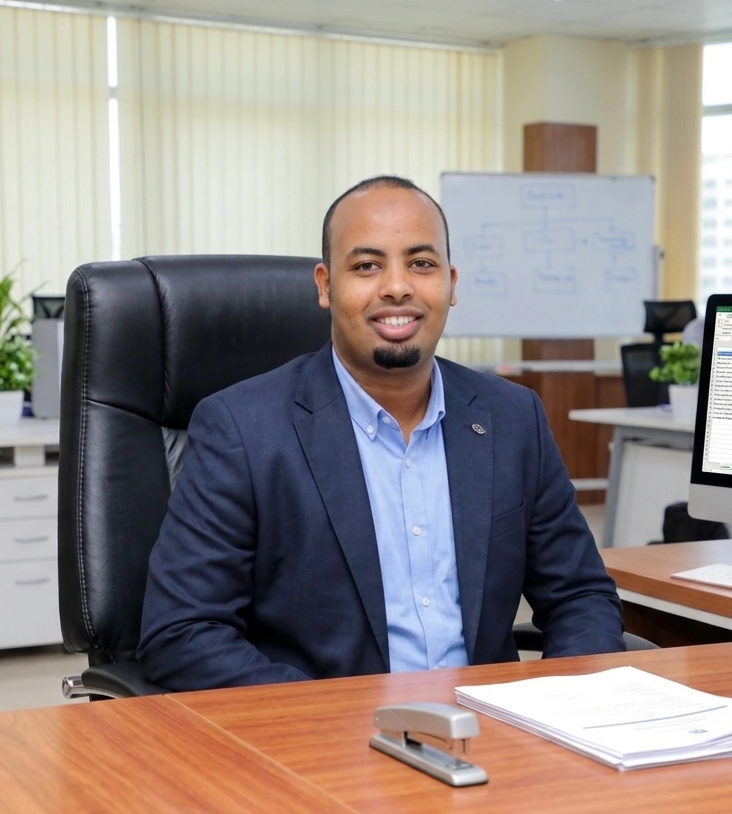
Eng. Mohamed Abdinour Mohamoud
Dean, Faculty of Engineering
Message from the Dean
Welcome to the Faculty of Engineering at East Africa University. Since our establishment in 2011, we have been committed to providing high-quality education and practical training in Civil, Surveying, Telecommunication, and Electrical Engineering.
Our faculty prides itself on combining strong theoretical foundations with hands-on experience, including laboratories, workshops, and real-world project management and construction site training. We aim to equip our students with the technical skills, ethical values, and innovative mindset required to meet the evolving demands of industry and society.
We also emphasize research, collaboration, and continuous learning, preparing graduates who can lead engineering projects, solve complex challenges, and contribute positively to sustainable development and technological advancement in our region and beyond.
I invite you to explore the opportunities offered by our faculty and join us in shaping a future driven by innovation, integrity, and excellence.
– Dean of the Faculty of Engineering
The Faculty of Engineering offers comprehensive programs designed to equip students with the knowledge, skills, and practical experience needed for a successful engineering career.
Undergraduate Programs:
- Bachelor of Civil Engineering – Focuses on construction, structural design, infrastructure development, and project management.
- Bachelor of Surveying and Geomatics – Emphasizes land surveying, mapping, GIS, and urban planning.
- Bachelor of Telecommunication Engineering – Covers network design, communication systems, and ICT infrastructure.
- Bachelor of Electrical Engineering – Includes power generation, distribution, electrical systems, and renewable energy.
Professional Development and Short Courses:
- Construction Project Management
- Advanced Surveying and GIS Techniques
- Renewable Energy Systems
- Telecommunication Systems and Network Management
Research and Innovation Opportunities:
Students are encouraged to engage in research projects, design challenges, and industry collaborations to foster innovation and practical problem-solving.

Established in 1998 as a non-profit institution, East Africa University is committed to transforming lives through high-quality education, innovative research, and dedicated community service. We equip students with the skills and values to become future leaders.
Quick Links
Get In Touch
Copyright © 2026, East Africa University | All rights reserved